

France and Western Europe have been plagued by a massive heat wave over the last ten days, already the second one of 2026 in the region. It is taking an unprecedented toll on people’s physical and mental health and is increasingly looking like a moment of truth, the moment we, a rich, developed group of countries are finally collectively coming to the realization that climate change is real, that it is happening now, and that it is going to deeply affect our own lives and futures. Of course the current news cycle will recede, people will go on holiday, and it’s likely we’ll get back to business as usual for a while (at least until the next heat wave, projected in just 10 days as I write this), but the frequency, intensity and consequence of these events is now going to physically enforce that we, our governments and media, are not going to be able to ignore the issue anymore and to just pretend we are preparing. In other words, in Europe at least, shit is finally hitting the fan.
As I have noted several times in this blog, our lack of awareness and sense of urgency in the western world about global warming, and our continued “growth” mindset, both in research and more broadly in our lives, has always been resting on one major, albeit not necessarily fully conscious assumption (at least not for a majority of the population): that both the state of our economical developement and technology would preserve the wealthiest of us (which I have no problem including myself in) from the worst, conveniently forgetting that the worst would be externalised “elsewhere” (the poor, the majority world, the tropics etc.). This imperialist individualistic mindset is not surprising considering the histories and economic doctrines of our rich countries, whose brutal immigration and even internal social unrest policies reflect this idea that we do not want to be confronted to the “negative externalities” that the necessities of our own development have inflicted to our “outside” world (see also: SUVs).
Unfortunately for us (but perhaps now fortunately for the broader world if it drives us to finally do something about it), the climate and ecological crises know no border, and places like Europe in particular are going to be deeply affected by global warming, the increased scarcity of water, the devastation of ecosystems and agriculture, and a subsequent rise in social inequalities and major health issues. Yesterday, on French TV a mainstream economic pundit “acknowledged the diagnostic” [of the reality of global warming] but blamed Christophe Cassou, a leading climate scientist and IPCC author for “not having done enough pedagogy about climate change, and for not warning that Europe would be an epicenter of the climate crisis”, to justify the lack of anticipation and preparation of our socio-economic system. Beyond the sheer bad faith of that dude (as the willing voice of capitalism on private TV), he genuinely seemed to discover that we too were going to be in trouble. The French extreme-right, which for years dubbed climate change as a scam, is now surfing on the latest (heat) wave for electoralist and (capitalistic) reasons, pledging a major national air-conditioning plan. Eric Ciotti, one of its prominents representatives, is arguing that we can’t adapt and that this is going to hit work productivity and the economy badly. Overall, the dominant productivist political class is finally starting to face its “rabbit caught in carlights” moment, a moment that both scientists and citizens paying even minimal attention had long seen coming. Of course very few in the political and media types care about the social and ecological consequences of any of this, but it appears that at least the wheel of physical reality has finally slowly but surely grinded the arrogant self-confidence of this bunch. So, whatever the reasons and motivations, it looks like we are facing a moment of collective reckoning. The question I would like to address here is: what does this mean for us, scientists and researchers ?
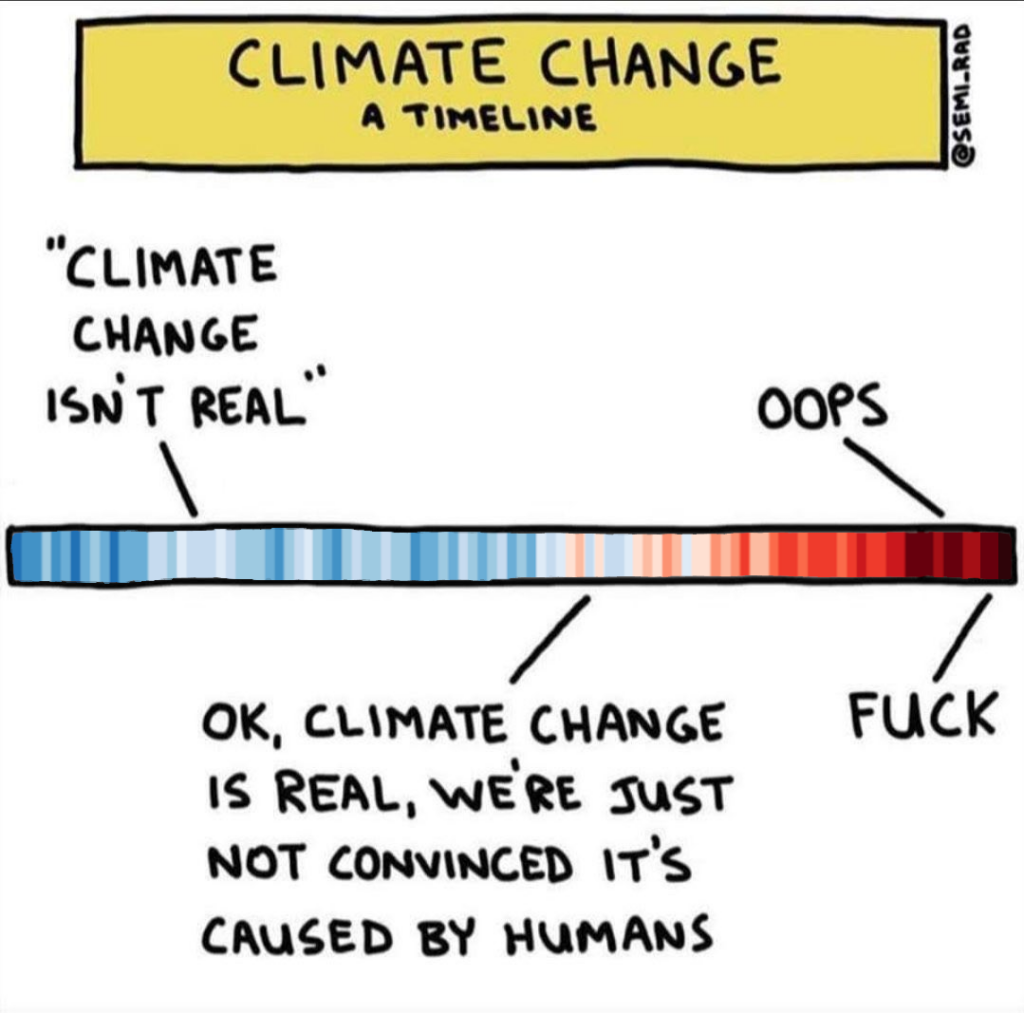
First, there can be no satisfaction being right about this “we told you so” moment. If anything, having to live through this, not just as scientists but as citizens and parents, means that we haven’t been so successful in our own mission. We need to come to terms with the fact that producing all that knowledge about the climate, the biodiversity crisis, warning for years about their consequences, thinking about alternative philosophical, sociological and anthropological worldviews of our relation with nature in peer-reviewed journals, as interesting and stimulating as it is, has at best only made a small difference to the global picture so far. It’s not to say that all of this has been useless. The IPCC reports and the COP agreements that they initiated are likely going to avert one degree off the worst-case +3.7 degrees RCP8.5 scenario, and will help to mitigate some consequences. That’s notable and welcome. But it still leaves us with a most likely ~2.5-3 degrees global warming planetary-average, endangering the survival of at least 50% of species on the planet, as well as a significant fraction of the human population (with Europe faring worse than average). A recent meta-analysis by Wiens & Zelinka in Global Change Biology tentatively forecasts “climate-related extinction of 14%–32% of macroscopic species in the next ~50 years, potentially including 3–6 million (or more) animal and plant species, even under intermediate climate change scenarios.” This failure to massively change course is of course not mainly our scientists responsability — unlike what political personnel and mediatic pundits now opportunistically try to spin to the people. However, as scientists passionate about our jobs and, for many of us, driven by our desire to make the world a slightly better place, it is nevertheless a scathing indicment of our own lack of leverage and positive relevance to the march of the world. Worse, a good deal of the science community should take a part of the blame for enabling the mindless development of technologies that have, and are more than ever contributing to the many problems humanity and the broader living world are facing.
Once we have acknowledged all this, if we can digest our disappointment and own failures, what is next ? For once, we clearly cannot afford to give up on our universal hopes, ideals and values. As I argued in a previous post, we must reaffirm and defend the necessity of an ethical and responsible science in service of a humanist and ecological society. More than ever, this means reflecting on the harm potential as much as on the good that research can do, and attempting to transform our relation to society to make research closer to citizens of all stripes — including those who currently feel most threatened by changes in our economic or agricultural models, and are to a great extent manipulated by powerful private interests. Our mission is to break this spell, and to find and promote alternatives, really hard. I do not think that there is any future for a world where ecological scientists continue to be viewed as a threat by a majority of farmers for instance. So we must work to open up, beyond the walls of our labs, from the ground, as any regular citizen interested in politics and democracy, and not specifically or at least uniquely as scientists. I do not think that collective “scientist movements” (like Stand Up for Science or Scientist Rebellion) are fit for this task, at all. In the current world of polarized politics, “sticking it to the experts” remains one of the most popular avenues of democratic expression, one that demagog politicians are all too happy to seize and that is all too easy to seize when they have official “elite” punchbags to punch. Blaming the elites (including scientists) continues to be an incredibly succesful electoral strategy for populist everywhere on the planet since at least Brexit and Trump’s first election, with ever more damaging consequences. We must be careful (and humble) not to do hand further free ammunition to them by presenting ourselves more or less explicitly as “those who know”.
The second point is that we shouldn’t be ashamed about what we have done either, and forget about everything that has and is still being done. If anything, we should be proud of the many things we have achieved in areas of research pertaining to the climate, to the environment and our relationship to it, in areas of research that have enabled such progress too, of what we are thinking about, and of our own early awareness of the issues at stake. There is no point dumping everything behind and deserting the cause now. Just because we haven’t been successful so far doesn’t mean that what we have done is useless, quite the opposite actually. The diagnostics had to be done, and they are just the beginning.
Finally, I would argue that we should, at least for an extended period (probably something like 20-50 years to start with), reduce the scope and goals of human research, and get all hands and good minds on desk to mitigate the catastrophe in front of us. If, finally, there is a societal reckoning that we are going to be screwed if we do not change course, then first there is still going to be a need for much of the research we have already done, and there is going to be an existential need for creative new research on a wide variety of issues directly pertaining to the mitigation and attenuation of the climate and ecological crisis, both in STEM and in the humanities. Now if the best of all times to make a difference and show the best of our human creativity, if there ever was any.
I increasingly think that what we need most is a broad and massive fusion and collaboration between the environmental disciplines of STEM with the humanities. Because all the key existential problems we now have to face have both a social, ontological dimension, and a biological, ecological and physical dimension. Picture an incredibly complex intermingled, entangled network of social, economical physical, ecological, and biological links that requires a complete reconfiguration. There is no point getting the biology or physics right if nobody on the planet beyond a bunch of geeks is interested or paying attention to it, if the social links are not activated and reconfigured based on this knowledge. Conversely, no democratic, economic and social program ignoring environmental facts, projections, and sensible attenuation measures (by that I mean measures that are not doing more harm than good, unlike much of geoeingineering fantasies) is up for the task if we want to survive the next century, and give a chance to the broader living world to survive too. Absent a change of course in our consideration of the ecology and physics fundamentals, that socio-ecological network sustaining our very existences is simply going to be annihilated — as Dexter Gordon put it with nuclear war, in an ecological and climate catastrophe all men will be cremated equal .
As researchers, we will need an unprecedented creativity and connection with citizens to avert this . This is hard but essential research, so what’s not to like ? But we also need to push hard to transform our own research institutions to open up, to take down walls between disciplines, to stop contributing to the problems themselves, and to prioritize the only thing that still truly matters : saving the best of our own humanity and human values by showing reflexivity, empathy and existential care for all living creatures on the planet. Let’s get to work and fight. Who’s in ?
















6 responses to “After the heat wave”
@Francois I'm in, mais je sais pas trop comment. (Je vais moins que jamais aller en conférence à l'autre bout du monde, mais rien qu'en parler dans mon labo est pas toujours simple).
@BrKloeckner @Francois Chaque discussion et affirmation des convictions compte dans notre milieu je pense. C'est un travail de longue haleine, générationnel, et on ne peut pas rester muet face aux poncifs d'impuissance, de non-responsabilité, ou de minimisation de notre rôle en tant que citoyens aisés.
Quant au reste, je dirais que c'est à chacun de trouver sa voie, ça prend du temps et il n'y a pas de recette magique. Pour ma part il y a en fait beaucoup d'improvisation dans ma propre démarche, je navigue à vue sur mes objectifs et engagements et au fur et à mesure il y a quelque chose qui se forme. Est-ce que c'est efficace et optimal ? Je n'en ai aucune idée. J'ai au moins l'impression que c'est préférable que rester encrouté dans les vieilles habitudes de la tour d'ivoire de ma discipline d'origine.
Au passage, ça commence à frotter pas mal avec ma communauté et les niveaux au-dessus, la démarche déplait a partir du moment ou elle interpelle et en fait réfléchir d'autres, donc je me dis que malgré les coups que je prends, qui ne sont pas très agréables et très décevants venant de collègues scientifiques, je suis sur la bonne voie.
@Francois
I wonder if it is worth checking the operating ranges of the temperature sensors used in the metatron and elsewhere at the station.
https://bsky.app/profile/richardkbroughton.bsky.social/post/3mqgwj5bspc2x
@Francois
I meant measurement ranges but probably not a bad idea to check the operating ranges too .