

One of my best friends and colleagues, Nuno Loureiro, who I had known for almost twenty years, was shot in his house in Boston on Monday, and tragically passed away shortly after that. He was a professor and researcher in plasma physics at MIT. It took me a few days to fathom the news and to digest the emotional shock. I thought I would pay him a little tribute today by posting a few lines about him and our relationship.
Nuno and I were the same age, and had very similar and parallel academic trajectories. We met, some time around 2007, through mutual friends and colleagues, when we were both postdocs in the UK and regularly travelling to the US for plasma physics schools in UCLA. After I got a position in France, I was still visiting Imperial College very frequently to work with Alex Schekochihin and Steve Cowley. Nuno was a postdoc working with both of them at the UKAEA fusion centre in Culham, residing in London. So we were meeting a lot, spending whole days and often evenings together, including at his place. He worked extremely hard in this period and had a really tough time, and I remember being super-happy when he got a position at IPFN, IST Lisbon. I visited him there in 2009 and, in 2010, he visited us in Toulouse to give a seminar at the astrophysics laboratory. We also spent a month together in that period, at a research program organised at the Newton Institute in Cambridge (UK), often having dinner together close to the bridge, and became close confidants.
Nuno’s PhD and postdoctoral work made him a rising star in a subfield of plasma physics called magnetic reconnection. Most importantly, his theoretical and numerical work showed how this process can proceed “fast” (in a particular technical sense) through the formation of plasmoid chains forming in electrical current sheets – consistent notably with observations of the solar atmosphere – rather than “slow”, as the historical theory of this process (the Sweet-Parker theory) predicted. The solution to this slow/fast reconnection problem had eluded scientists for 50 years, and his work was instrumental in breaking this theoretical gridlock. I invited him in 2013 to give a lecture on this topic at a plasma physics school I organized in Les Houches with other French, US and German colleagues. Nuno was a great physicist but also a great communicator, and he notably dubbed some of the reconnecting magnetic structures his simulations produced “monster plasmoids”, a term I was very fond to use to make fun of his academic marketing talents.
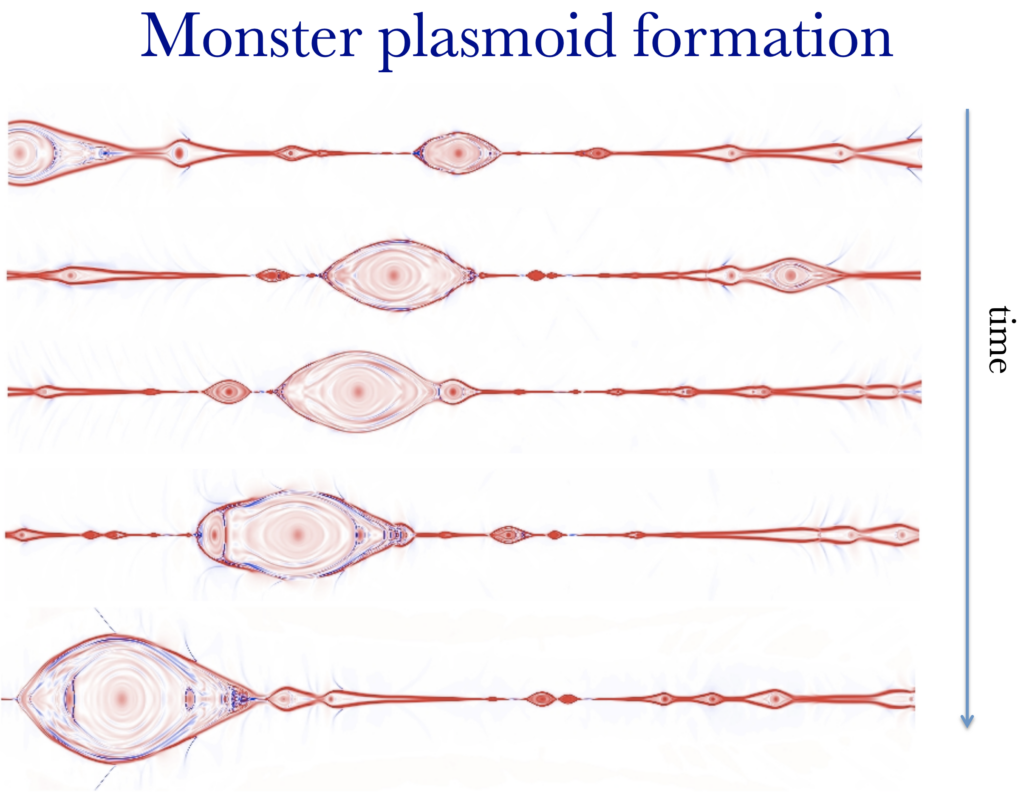
A slide from Nuno’s 2013 Les Houches lectures, showing how a distribution of magnetic island plasmoids form in an electrical current sheet when two magnetic fields lines of opposite direction come together.
Our trajectories started to diverge in 2016, when he left his position in Europe for MIT. It is there that his academic career really took off, and since then he had been going up through the ranks like a rocket, culminating last year in him becoming head of a major centre for plasma and fusion science (PSFC) at MIT.
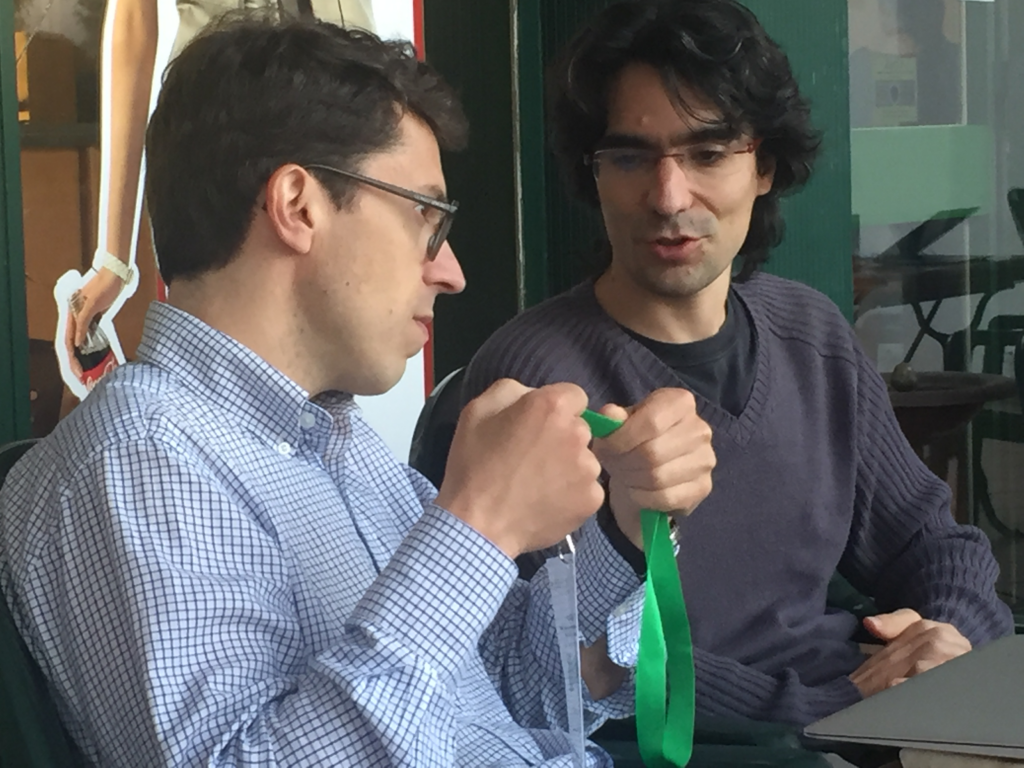
But enough with academic track records and scientific accomplishments. What I really want to evoke now is our scientific and human relationship. Alex, Steve and a few other close colleagues have already paid homage to Nuno’s exceptional human and scientific personality today in the New York Times, and I can attest that everything in this article is both accurate, as well as absurdly sad and tragic when you reflect on this week’s events. Nuno was a great human being before being an enthusiastic, talented, and extremely hard working scientist. He had a true gift for social relationships, and for making his students and colleagues feel valued. He was also not the kind of person to fall for bullshit, and was well-known for, and hilarious in his ways of making fun of pompous attitudes often encountered in academic research. “Cut me the bullshit” was one of his favourite sentences.
For all these reasons and more, for many years Nuno was my twin brother in spirit, in scientific arms, in humour and in life in this community. We were extremely similar yet very different: he was very driven, organized and methodical in the way he approached science and his academic career, focusing on a few selected plasma topics (magnetic reconnection, Weibel, magnetized turbulence), going all in on them. I am a butterfly browsing every possible astrophysical flower, not having to brand myself after a particular topic, or being forced to deal with US academic research career and management shenanigans (there was much more funding available in the US, which was one of the reasons Nuno left Europe). I see myself as an impressionist painter in physics, touching a bit of everything and leaving new ideas I explore on the side after just one or two papers. He thought this poetic vision of scientific research of mine was bullshit, and told me so without pulling punches, in his very own usual ways. He thought that his mission was to pick a subject, dig deep into it, do the hard work and deliver. Unlike what other colleagues thought, it was not surprise to me that he felt at home at MIT.
Many times, we had arguments on why we were here, what it meant to be a scientist, how to pick research subjects, how deep to dig into them, how to run an academic career, how to manage students and people (and he had many more to manage than I did in recent years). We had a bust-up once, at the Niels Bohr Institute in Copenhagen, as I thought that his ingenuous spirit and research personality were waning after a few years in the US. For months, I was very saddened about this incident, feeling I had lost the connection to an old accomplice. Fortunately, we had an emotional reconciliation the year after, in les Houches again, one of the core places of our relationship. That’s when I think I truly recognized the deep value of our friendship, and what makes this week’s dramatic developments even more painful to me . We were both very (and uncompromisingly) honest to each other and deeply caring for each other, having high and lows but never losing track of our shared story and of our work.
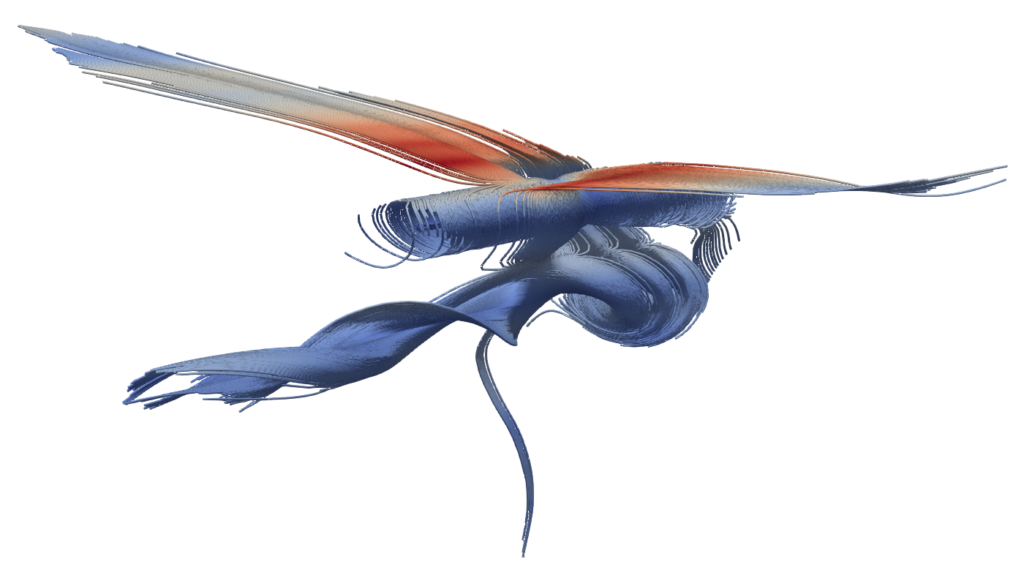
We never published anything together, but were close to start something in 2021 after I found hints of reconnection plasmoids in simulations of magnetic field generation in turbulent fluids in regimes of high electrical conductivity. I sent him and a few other colleagues emails about “current shit”, including snapshots of weird helical magnetic field configurations I had spotted in numerical simulations, such as this strange magnetohydrodynamic creature I dubbed the Gallowayraptor (those who know know). He told me he was going to stick it as a poster to his office door. I don’t know if he did, because unfortunately I never visited him at MIT, having stopped to fly translatlantic in recent years. He was also very excited (much more than I was, actually) about a result I obtained back in 2016 on magnetic-field generation in collisionless plasmas, which he, his former PhD student Muni, and other close colleagues later went on to expore deeper and further.
Nuno’s death is a major loss for the plasma physics community and for the broader world. You don’t encounter many colleagues like this in your life. He was truly one of a kind, and we need more Nunos in this world. Losing him, a brilliant and now well-established colleague in the US, feels particularly weird and disturbing in the surreal times that US science is currently living through.
I feel so privileged to have met Nuno, to have been one of his close colleagues, and to have shared so much scientifically and personally with him throughout these years, including both mutual admiration and well-deserved occasional snark that kept us both in check with our original values. He surely made me a more mature scientist. It is very hard for me to imagine the future without him but, more than anything, my thoughts and love go to his family, to his wife, and to his many grieving friends around the world.




2 responses to “Nuno”
@Francois That's horrible. I hope you get the time and support you need to deal with this.
@Francois
How can such things even happen ? I wish you the support and strength to cope with this horrible event.